
About a ten-minute walk from my home, a collection of street blocks makes up an area called Midan El-Gamea. An expat friend of mine once referred to this area as one of the Home Depots of Cairo. While actually composed of many shops, these streets host distinct sections that reflect the departments in your typical home improvement store: lighting, hardware, plumbing fixtures, and more.
I always feel more like a local when I purchase something from these shops rather than making the trek out to IKEA—and even more like a local if I order something to be custom-made. Earlier this year, I did just that to get the full-length mirror that I wanted to stand in the corner of my bedroom.
As the day to pick up my order approached, I realized that I had no clue how I planned to get this mirror back to my apartment. While I have carried some pretty bulky items home from Midan El-Gamea, I figured that this mirror might be just a little too big. That meant I had to do one of the tasks that still seems to be the hardest for me to do here in Cairo.
I had to ask for help.
So one evening after work, I hopped into the car of a friend and, together with another friend, we made our way to pick up my mirror. Here are how the events unfolded:
- My mirror was not yet ready (classic), so my friends advocated on my behalf for the shop to get it done right away that evening. And then they waited with me.
- We struggled and giggled together to fit this six-foot mirror into the small SUV and then made our way back to my apartment.
- My two friends carried the mirror up the five sets of stairs to my elevator-less apartment, barely letting me carry any of the weight.
- They helped me position it in my room and unwrap the bubble wrap in order to see the final product in its place.
From start to finish, these friends generously helped me complete a simple errand that I had been embarrassed to ask for help with in the first place.
While I often feel like I need to have the capacity to do everything myself, my friends (specifically my Egyptian friends) repeatedly remind me in word and deed that they not only can but also desire to help me.
So many examples come to mind to illustrate this truth. I’ve had multiple friends pick me up at the airport at two in the morning. I’ve rung a friend for translation help when I can’t seem to explain myself to an eye doctor. A family I love as if they’re my own hosts me every Christmas Eve night so I’m not waking up by myself on that holiday morning, and then another extended family invites me over a couple weeks later to celebrate Egyptian Christmas together on January 7.
The list could go on forever.
Accepting (let alone needing or even craving) these acts of generosity can prove difficult, especially when I have this skewed notion in my mind that I, as the expat who has raised support to be here, am the one who is supposed to be “more” generous or who is supposed to not require anything from anyone else. I mean, what kind of illogical nonsense is that?
My friends demonstrate how to practice generosity in real, down-to-earth ways, even when it’s not convenient for them. But it’s not just generosity that they are showing me. It’s evidence of what community should be.
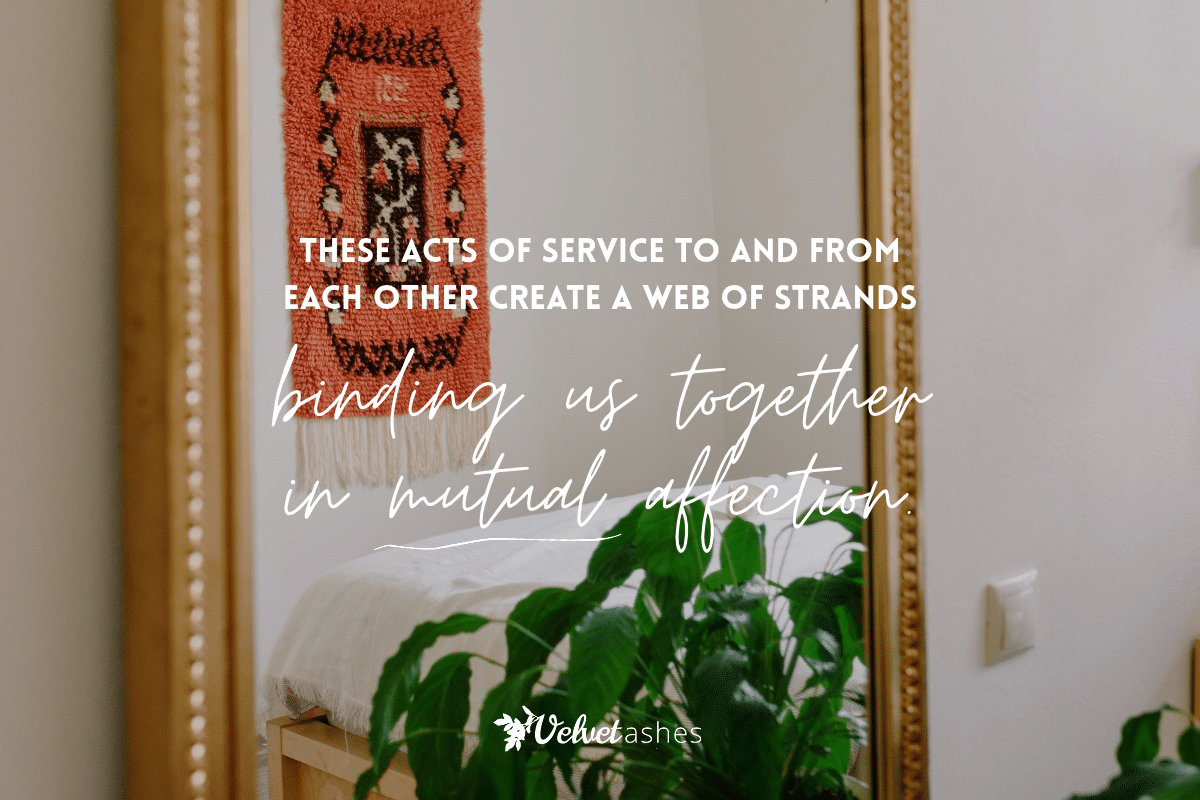
Coming from a land of individualism, I can forget what interdependence looks like. How we are called to give of our time and efforts, not for our own self-righteousness, but for the care of others. These acts of service to and from each other create a web of strands binding us together in mutual affection. When I consider this metaphor, I realize that holes will form in this web in one of two ways: if I’m unwilling to give, but also, if I’m unwilling to receive.
So may I follow my friends’ examples of practical generosity. May I sign up for the Meal Train and take the visitors to the pyramids yet another time. But also, may I continue to ask for help when I pick out furniture or when I have to go to the doctor. May we keep spinning this web together.
What is a practical way that you can either give or receive generosity this week?