

Years ago, I worked in the events and fundraising department at the seminary where my husband attended. Tables had to be set just so—crisp linen tablecloths, polished silverware, shiny crystal, and china plates. Each table needed to look identical and perfect, right down to the dessert fork placement and folded napkin. I will never forget the name cards that seemed to haunt me in my dreams during event weeks.
I didn’t really mind. It was exciting setting up for events, greeting trustees, board members, and alumni donors, making them all feel cared for and special.
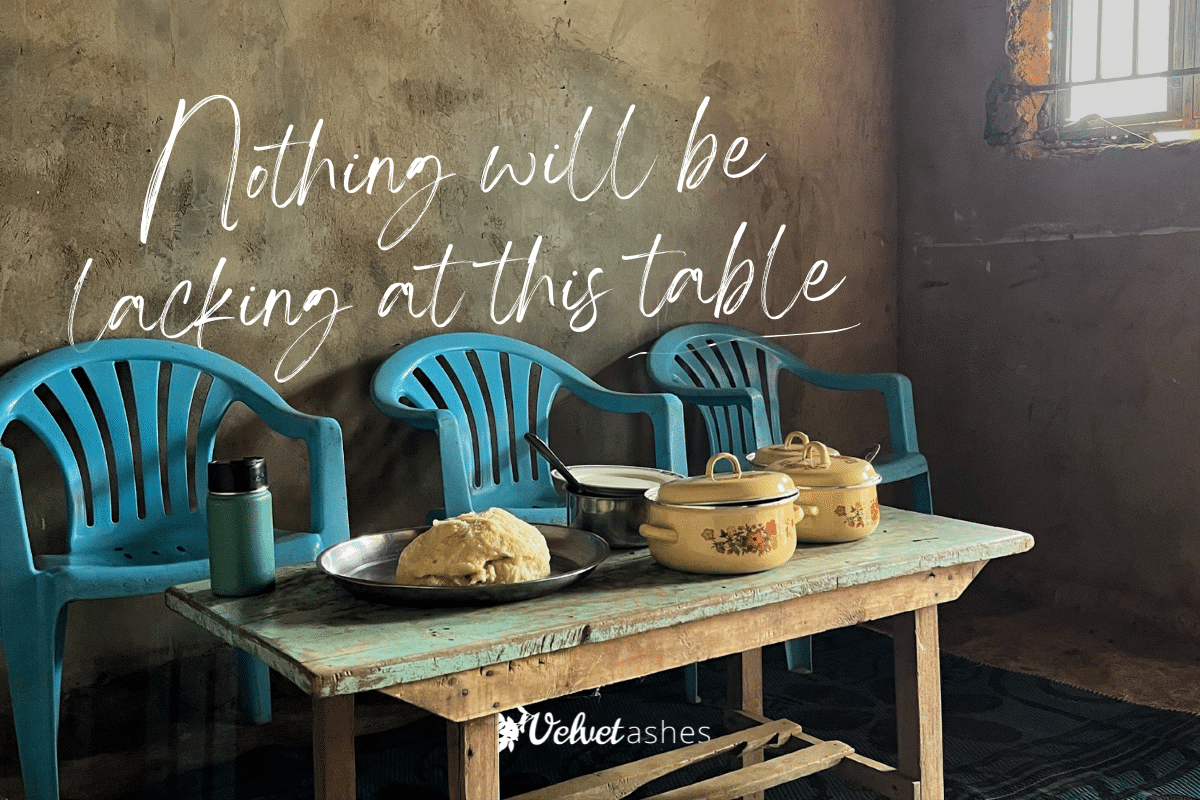
Fast-forward eighteen years to Africa, when I was the one being made to feel cared for and special in a simple, two-room Ugandan house with an unfinished ceiling, two windows, and a dirt floor partially covered by thatch mats. A small wooden table with chipped blue paint had been placed in the eating area with three chairs, just waiting for lunch. On the table were plastic plates and cups, dingy silverware, and cream and brown cooking pots with white flowers that looked like they were from the 1970s—a far cry from shiny crystal and china plates.
A friend and teacher of the local language, Scovia, had welcomed me, my teammate, and our summer intern into her home for a day of cultural inclusion. The look on her face was one of delight as we started the day with tea accompanied by a slice of pumpkin she had grown at her house. After washing the tea dishes, we immediately started on lunch prep. Thankfully her husband was around, and he did not ask us to “ready” the chicken. Scovia and her two children tended to the chicken while fielding questions from the three of us about chicken prep and other foods. Once the chicken was in the pot and boiling, she divvied up the rest of lunch prep between the three of us, smiling all the while as she patiently explained how to cut or chop each food item. Beans, vegetables, chicken, potatoes, fruit—Scovia proudly and happily prepared a feast for us.
I carried the pot of beans from the kitchen to the eating area, set it down on the table, and stepped back to soak in the scene. The sun was streaming in the window and open door, creating a beautiful effect of light and shadows around the room. I pulled out my phone and snapped a quick shot. The words from Psalm 23 rolled around to the front of my mind, “You prepare a table before me . . .” Now, this woman was by no means my enemy, but the first part of that verse stuck in my mind for the rest of the day. She had prepared a table before us with her best and with pride and care, just as I had done for the seminary-event guests.
Eating in local homes in your host country can mean you never know what will be placed on the table before you. As we sat down to eat, a few of my nerves tingled as I thought, Will it be tasty or edible? Is the chicken finished cooking? Will I have a gag reflex? Will I offend my lovely host and friend if I do not take some of everything, or can I pick and choose? What is everyone else taking to eat? I scolded myself a bit. Scovia was our friend; she would not give us anything that would cause us to be ill. She carefully and purposefully chose what to prepare that day, and she proudly gave us her best.
This is an easy one to carry over into our hearts: our home with God. He prepares for us a table in each of our life circumstances. As our host and friend, he sets these tables with all the necessary things. Nothing will be lacking at this table; he gives out of his abundance.
There are still questions for us to answer. One being, how are we coming to this table? Are we asking if we can pick and choose? Do we have a gag reflex? (Sometimes!) Are we avoiding the hard-to-swallow circumstances? (You know it!) Are we rushing through the vegetables (times of growth) to get to dessert (good times)?
Who is around your table? What do they need? How can you serve them?
What is offered to us at this table? It could be hard health issues, difficult situations with team members, the national people you serve daily or weekly, homeschooling your children, etc.
Whatever the circumstance, whoever is around your table, this is what God has prepared for you. The Holy Spirit enables us to live out his fruit of love, joy, peace, patience, kindness, goodness, gentleness, and self-control at the table. We bring compassion, humility, acceptance, and forgiveness to our circumstances. We bear with one another, surrendering our thoughts and our table talk to Christ’s leading as we navigate the everyday realities around the table.
When I came to Scovia’s table, I did not demand familiar foods, shiny dishes, or a name card. I accepted all she prepared with gratitude and humility. It’s the same with the table God has prepared for us. We can complain or demand better situations, but hopefully we learn to come to the table with prayer, gratitude, and humility by accepting God’s work in our lives.
What situation has God currently prepared for you? How do you need to respond?
Table image photo credit: Marianne Colee












2 Responses
I thought this picture was from Zambia, the nation I have been in for 10 years now. It’s identical to the table, chairs, pots, and Nshima (the maize meal staple) we eat often. So sweet and meaningful, thank you for sharing this!
Wow! Beautiful story. I have been in South Korea, in a local, not fancy home. I have been in other places in north Asia, and eaten the best they had to give us. Simple, but with gratitude. Beautiful story.
Carol of Corea and Michigan