

There is an oft-quoted adage among gardeners in regards to perennials and their growth: “The first year they sleep, the second year they creep, and the third year they leap!” Perennials need to gradually establish themselves before any kind of significant growth.
I have been reflecting on this saying and its meaning as I ponder our experience of home in the Middle East this past decade and, especially, the last six or seven years since we moved to the Southern Levant region and eventually back to the States.
Our last summer in the Arab world was wonderful. Towards the end of it, one of our girls said, “I finally decided: [host country] is my home.” We had just completed our fifth year there. We had been in a new house for almost a year, and we were feeling settled. That house was beautiful and had space for so much: for hosting, for celebrating, for outside fun. Our kids had spent the summer climbing trees and listening to Harry Potter while building things outside. We gathered every week with friends to worship in English, and we hosted a Fourth of July celebration. We camped with friends in our backyard and ended the summer hosting an art camp for expat and local kids.
Our home—the life we had together as a family—felt like a big oak tree, strong and sturdy. It was abundant, with a wide and spacious canopy that enabled us to generously provide shelter and welcome. If the adage about sleeping and creeping and leaping is true, we were certainly leaping our fifth year. Our roots finally ran deep in the community, and we had a sense of safety, belonging, and purpose.
But then, in the fall of 2023, our oak tree started to be beaten down, by rain at first, then a storm, and finally, a hurricane. War in Gaza broke out, just about eighty miles from where we lived. Uncertainty and fear ensued, as well as deep concern for our Palestinian neighbors and friends. We felt deep grief and anger at the injustice of it all. Then we experienced really serious opposition from our neighbors. We felt hyper-vigilant in our own home, not sure when someone would next show up offended or angry.
And then my husband’s health—that had been, in some ways, barely holding on that whole year—took a turn for the worse. We took a sabbatical, but that wasn’t helping. So we made the very difficult decision to return to the States in February 2024, hoping that in six months, we would be able to return to the field.
Our strong oak felt more like a vine without a trellis. Thankfully, we still had each other, but my husband was mostly in bed, and I functioned like a single parent. We had endless appointments, while I also homeschooled our kids, kept some of our traditions and rhythms, and walked with them as they grieved our life overseas. Also during that period, my sister-in-law, who had been battling cancer, advanced to stage IV, and we knew we were facing the last months of her life.
Even though life was so painful, we started to build a trellis. We made our temporary home a sacred space. We decorated it with watercolor drawings and pictures of people and places we loved. We welcomed college students into our messy life. They helped us with our kids and with laundry and cleaning when I had no strength for anything else. We hosted them for meals and game nights.
We celebrated all of our birthdays with friends and fun themes and counted our daily points of joy. We played as a family when we could, my husband playing card games with our kids on the bed and joining us for family movie nights on a recliner. We started to get to know our immediate community, joining in for parades and playdates in a church parking lot and going on hikes in a nearby nature reserve with friends. We made meals for others and gave an elderly woman rides to church. We made countless trips to the library and became good friends with our amazing librarians. Our roots were not quite transplanted, maybe more like kept alive by hydroponics, but we needed our trellis nonetheless.
In mid-July we found out that my husband had a benign brain tumor that needed to be removed, and so, in September, it was. At that point we were in the middle of the hurricane. My sister-in-law died, my husband’s post-surgery recovery was brutal, and we realized we were not able to return to the Middle East to live, which had been our hope all along.
The storms of destruction had not spared us. They took our home, our community, my husband’s health and companionship, my sister-in-law’s life, and everything that each one of these things represented: strength, belonging, deep knowing, friendship, sisterhood, and emotional safety.
I have really wrestled with the Lord for months about why he chose to transplant us back to the States when it had taken so long for our family to get to a place of leaping. We had so wanted stability, for our children especially, and it felt like we were finally getting there. We had begun to harvest trust in local relationships. I loved the vision for ministry, both at home and outside the home, that the Lord had given me. I felt my life fit me like a glove for probably the very first time ever.
We were bleeding (still are) from so many different cuts. I survey loss upon loss upon loss now with a pang of grief that I feel in my stomach, as if someone had punched me over and over and over again, and I am on my knees hunched over.
~~~~~~~~~~~~
I went on a drive after writing the above. As I slowly drove back home, the Spirit gently whispered, What if I am your everything? What if I am not just your wise gardener, but also your sun, your soil, your water?
What if with every transplant and every cut, he is giving us himself as the better everything that keeps us alive?
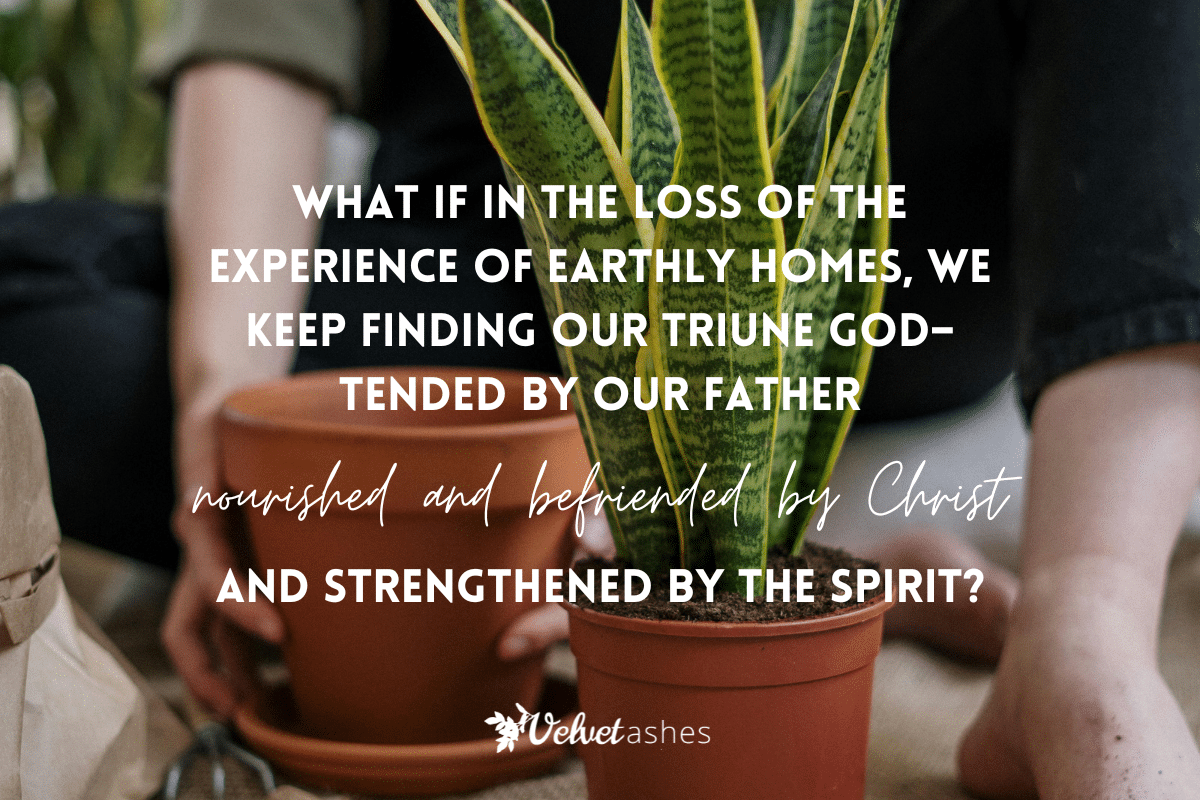
What if in the loss of the experience of earthly homes, we keep finding our triune God—tended by our Father, nourished and befriended by Christ, and strengthened by the Spirit? What if the pain is ongoing and hope is deferred and prayers seem unanswered, and we are still okay? What if the better thing is to grow roots really deep into who God is, always for us in Christ, especially in the places of most hurt?
What if this is when we know we are home?







11 Responses
Thanks for writing this. I lived in Poland for 25 years. Like you I had finally became one with the people, culture, and the rhythm of life. I discovered that many ways I had adapted I didn’t want to relinquish. I discovered that I didn’t know how to live, and abide in my passport county. Be encouraged. The roots do finding footing again. Jesus reveals new loves.
That is encouraging, especially “Jesus reveals new loves.” Glad that the Lord has grown new roots for you!
Wow. Great story. Real story. Honest story. Our US Sunday School group is talking about John 15 and abiding in Christ these days. This fits. Thanks for sharing.
Carol of Michigan and Corea
Carol- thank you! yes, that is what the Lord has kept me thinking so much about – about what abiding really means.
Thank you for your vulnerability and for this beautifully written reflection. I cried – good tears. I have much to pray and meditate on.
May the nearness of Christ be with you in tangible ways as you meditate on all these things…
Thank you, Lilly, for sharing this. I’m in the same region and feel the same gut punch in the stomach that you described beginning in October 2023. I’m so sorry for the losses and pain and storms you achingly described. The Spirit’s question to you is deeply challenging to my soul too. In the face of pain, we keep finding Him trustworthy, and our roots keep going deeper, and somehow (illogically) there are new leaves and taller growth. Praise God! And thank you for your vulnerability with your story.
Oh wish I could meet you. It has been brutal for the region. And yes, I love how the Lord keeps us flourishing through him even in the driest of seasons
That is encouraging, especially “Jesus reveals new loves.” Glad that the Lord has grown new roots for you!
Thank you. This is so good! We have been displaced by war and feel so much grief. Your conclusion here is just what I need.
Thanks for these words and letting us listen in on what God is speaking to you.
I’ve been reflecting on how belief that he is my better everything seems to fulfill the commandment to love the Lord my God with all my heart and soul and mind.